


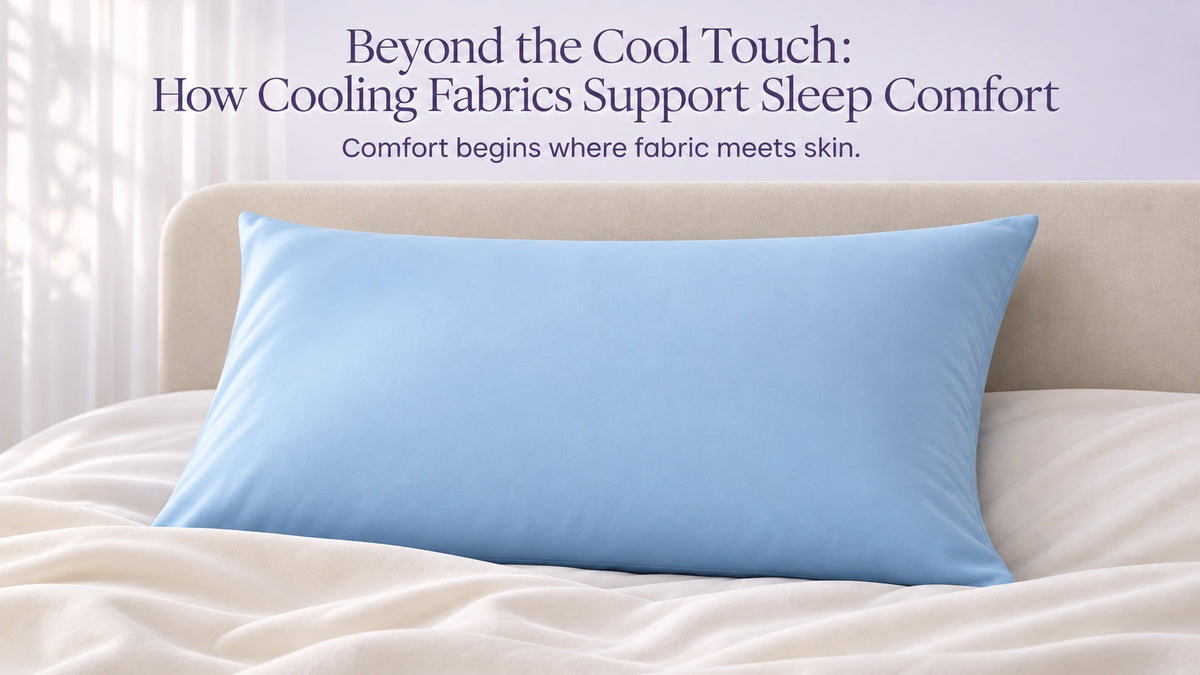
You turn the pillow over, looking for the spot that still feels fresh.
A little later, you move your shoulder away from a patch of bedding that feels slightly clammy.
Then one foot slips out from under the covers, even though you still want the rest of you tucked in.
These are small adjustments. You may barely notice making them. Yet they point to something specific about comfort: how the fabric feels where it meets your skin.
That is a useful place to begin when thinking about cooling bedding. The first cool touch is easy to recognize. Understanding what happens to heat and moisture after that helps explain how a fabric can contribute to a more comfortable place to rest.
01 / CONTACT COOLING
The Pillow Feels Warm Exactly Where Your Cheek Rests
The room can feel comfortable while one part of your pillow feels a little too warm. You move your head, find a fresher patch, and settle back down.
When skin touches a cooler textile, heat passes from the skin into the material. The rate of that initial exchange helps explain why two fabrics in the same room can feel different against your cheek.
 A familiar adjustment brings attention to the fabric beneath your cheek.
Cooling fabrics are designed to make that contact feel refreshing. One way to describe this property is Q-Max, a measure of the peak heat flow when a warmer test surface first touches the fabric.
Under comparable test conditions, a higher value indicates a stronger initial cool-touch sensation. KAKEN's contact-cooling test explanation describes how this is measured.
For a pillowcase, that gives the cooling feature a very specific role: the sensation at the surface where you rest your face. The fabric will still warm as it takes in heat. Its first-touch performance and how it feels during longer contact are related, but different, parts of comfort.
02 / MOISTURE MANAGEMENT
The Bedding Is Not Soaked, but It Feels a Little Clammy
Sometimes the sensation you want to get away from is a faint dampness. The sheet feels close against your shoulder, or the pillowcase feels less fresh than it did when you lay down.
This is where moisture management belongs in a conversation about cooling comfort.
Absorption, wicking, and evaporation do different jobs.
- Absorption is the uptake of moisture.
- Wicking moves liquid through or along the fabric.
- Evaporation allows water to leave as vapor.
A fabric can perform differently in each of these areas; soaking up moisture does not, by itself, tell you how readily it moves or dries. NC State's textile comfort laboratory evaluates these properties separately.
For the person in bed, what matters most is how the surface feels against the skin. Moisture movement can help make that contact feel less damp when the surrounding conditions allow moisture to escape. This is why a cool-touch surface and moisture-handling performance deserve separate attention when choosing bedding.
03 / COMFORT UNDER THE COVERS
You Want the Covers On, Just Without the Stuffy Feeling
You pull the covers back because you feel too warm. A moment later, the exposed shoulder feels chilly, and you pull them up again. What you wanted was a comfortable amount of coverage.
The space between your skin and your bedding has its own temperature and humidity, often called the bed's microclimate. The fabric on the surface, the layers around it, and the room all contribute to that experience. Elegear's guide to Arc-Chill Cooling fabric explains why construction and surrounding conditions matter alongside contact cooling.
Breathability adds another part of the picture. Air permeability concerns air passing through fabric; water-vapor resistance concerns how readily vapor can pass through it. These properties help describe different aspects of that close-to-skin environment. Textile testing specialist Hohenstein evaluates heat, moisture, and skin feel as distinct contributors to comfort.
This gives cooling bedding a practical role within a bed you already enjoy: a refreshing contact layer, considered alongside the warmth and coverage you prefer. A thick extra layer still matters, even when the surface underneath it feels cool initially.
Comfort next to your skin
Three ways fabric shapes comfort
A cool first touch is one part of the picture.
Contact cooling
Cooler fabric · heat flows on contact
Heat moves at first contact.
Q-Max describes initial contact cooling, not an all-night temperature.
Moisture movement
Liquid moisture
Wicking shown · liquid spreads in fabric
Moisture follows its own pathways.
Absorption, wicking, and evaporation describe different parts of the process.
Breathable construction
Air passing through fabric
Air permeability · shown schematically
Construction affects airflow.
Airflow and water-vapor resistance are related but distinct properties.
04 / THE MATERIAL DESIGN
How Arc-Chill® Brings These Details Together
Arc-Chill® cooling technology is designed around the interaction between skin and textile. Its material framework includes mineral-integrated fibers to support heat movement, engineered yarn structures, and fabric pathways designed to guide moisture. The configuration depends on the material and its intended use.
As an officially authorized Arc-Chill® partner, Elegear integrates the technology into selected bedding products, considering the cooling surface together with the finished construction. You can read more about that approach in Elegear's introduction to Arc-Chill® cooling technology.
That also explains why “cooling fabric” and “ordinary fabric” are not two uniform categories. Fiber content, yarn structure, thickness, and finishing all contribute to how a particular textile behaves. Comparing specific products is more useful than assuming that every cotton, bamboo-derived, or synthetic fabric will feel the same.
The useful questions stay close to the experience: How does the surface feel on contact? How does the material handle moisture? How does the finished product fit with the rest of the bed?
05 / THE PILLOWCASE
A Small Place to Start: The Pillowcase
 Start with the surface that feels uncomfortable, while keeping the bedding you already enjoy.
If your pillow feels right for your head and neck, but its surface often feels too warm against your cheek, the pillowcase is a focused place to explore a change.
The Elegear Arc-Chill Cooling Pillowcases combine a cool-touch surface with a smooth feel and a hidden zipper. The product listing specifies Q-Max >0.5 and describes the material as breathable. That Q-Max value relates to initial contact cooling; it is not a measurement of moisture transport or a promise of a fixed temperature throughout the night.
Picture the change in an ordinary bedtime routine. You keep the pillow you like and the covers that give you the right amount of warmth. The new element is the fabric directly beneath your cheek. Select the size that fits your pillow and follow the care label for that particular product.
If the uncomfortable contact is mainly beneath your shoulders or back, a cooling sheet may be the more relevant surface to consider. The layers underneath it still play a part, so begin with the location of the discomfort rather than replacing everything at once.
06 / EVERYDAY COMFORT
Comfort Lives in the Small Details
The warmer patch of pillow. The slight dampness against the shoulder. The wish to stay covered without feeling enclosed in too much warmth.
Cooling fabrics give us a way to think about these everyday sensations more precisely: contact cooling for the first touch, moisture management for a fresher-feeling surface, and fabric construction that works with the rest of the bed.
Those details can matter in a warm bedroom in any season. At Elegear, they are part of how we think about bedding people want to settle into.
Cooling is more than a seasonal feature. It's part of sleep comfort.
Explore Elegear cooling pillowcases and find a surface that suits the way you rest.

اترك تعليقًا
This site is protected by hCaptcha and the hCaptcha Privacy Policy and Terms of Service apply.